Timeline
Sixth Age
Named in the public announcement Still open
RS4 is set in Gielinor in the Sixth Age. That age sits years after RuneScape: Dragonwilds and years after the destruction of the Dragon Queen Kuldra. The opening land inside that age is Ashenfall, a landmass to the north-east that Dragonwilds explored first and that has since changed.
An age, here, is a historical shelf, not a season pass. It tells you the story is later than the survival game and later than Kuldra. It does not hand you a year number, a list of gods who are active, or a statement about which older quests are treated as history. The film's rider is the clearest figure the age has been given so far.
Set in Gielinor
Gielinor is the world. That single word ties the new project to the setting of RuneScape rather than to a new planet with a rhyming name. The game is set there and begins in Ashenfall. Players who know the older map can hear both the continuity and the limit: this is the same world, and the published start is one north-eastern landmass.
Being set in Gielinor does not mean every city, altar, and dungeon is in the first reveal. Ashenfall is only the beginning, and that line is what points at the rest of the world. Known places and new places are both the direction of growth. No chart shows which of the familiar regions are first in line. The world name is the commitment. The itinerary is not written.
A city checklist is not part of the October 2026 news. What is public is the world name, Gielinor, and the land where the story opens, Ashenfall, north-east of that world. The Sixth Age is the shelf those two names sit on. The rest of the map is an ambition, not a route.
Years after Kuldra
Kuldra's destruction is the historical marker. The new game begins years after it, not during it. Dragonwilds sits on the earlier side of that gap. The years are not counted in public, so 'years after' is the whole measurement. A specific date for the jump would be a number added from outside.
Ashenfall has changed across that gap. Returning Dragonwilds players should not expect a frozen copy of the survival map, and everyone else can treat the land as having a past in the same story. What changed, building by building, is not itemised. The film is the illustration: islands, a town, snow, and dragons in a later light.
If a later telling gives the gap a number of years, that number will be new. No count of the years was given with the October 2026 news from Birmingham. Order is the fact: Kuldra falls, Dragonwilds explores Ashenfall, then RS4 begins in a changed Ashenfall during the Sixth Age.
The rider in the film
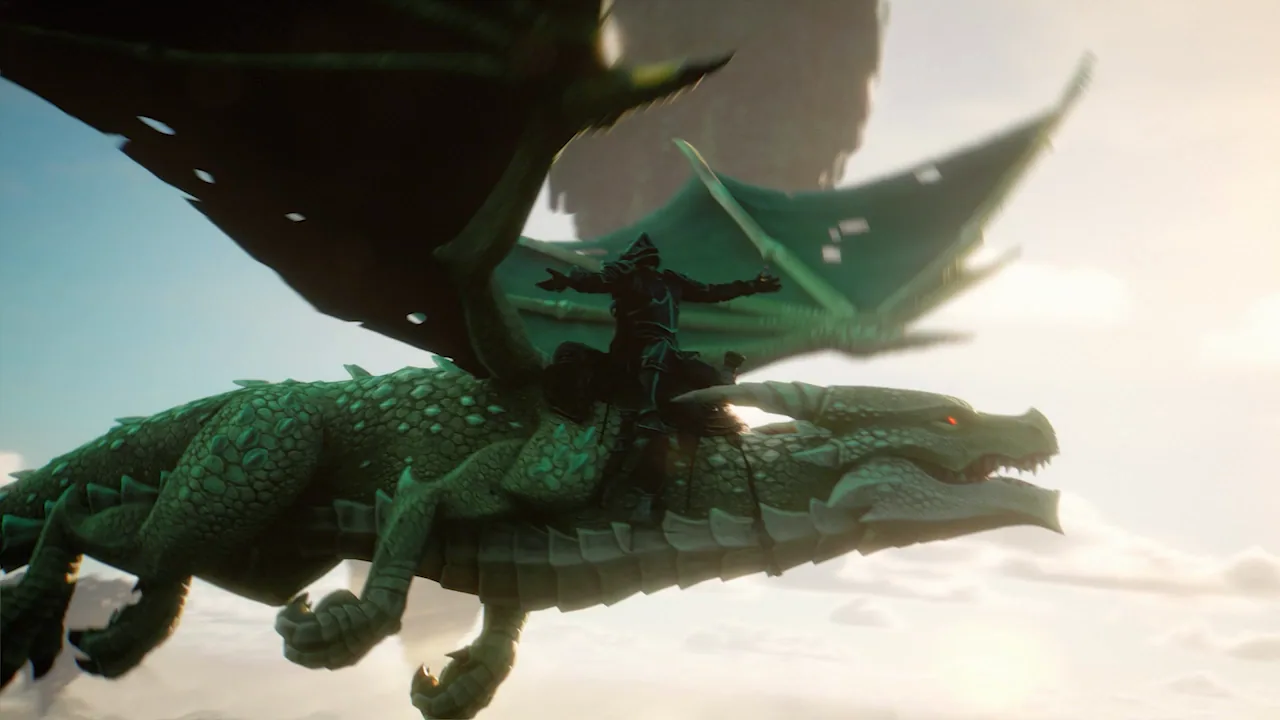
At about half a minute, the concept film shows a hooded rider on a large green dragon with a red eye. The rider is not named. The dragon is not named. The shot is still the most specific person the Sixth Age reveal has: one figure, one mount, one colour note on the eye. It is a costume and a silhouette, not a character bio.
A three-headed dragon attacking a rider is not what the frames show. The film has more than one dragon, including a pass of green, red, and blue-grey over a walled city, and this separate shot of a single green mount. Hold the rider as a film image until the figure is given a name.
The red eye is a colour note on the mount, not a title, and the hood hides any face the film might have named and did not. Around twenty-two seconds the three dragons pass the city. Around thirty seconds the rider is alone on the green mount. Those are two shots in the Sixth Age's opening land, not a boss introduction.
Dragonwilds is earlier
RuneScape: Dragonwilds remains its own game, with its own team, and it is where Ashenfall was first explored. The Sixth Age project starts later in that land. Order matters. Dragonwilds is not a prologue chapter stored inside RS4, and RS4 is not a mode selected from the Dragonwilds menu. They share a place name and a sequence in time.
Sharing Ashenfall does not move inventories, levels, or servers. No transfer has been described. The relationship that was described is independence: the new experience sits alongside Dragonwilds. When you read Sixth Age, read it as the historical position of the new game, after the survival exploration and after Kuldra, with the earlier game still standing on its own road map.
Play Dragonwilds for its own sake, and read the Sixth Age project as a later neighbour in the same land, not as a chapter select hidden inside the survival menu. The survival save stays where it is. The new game's team is separate, and the survival game's team continues.
What an age leaves open
Naming the Sixth Age does not settle combat, skills, membership, or the day you can play. Those stay on the list of questions that are too early to answer. An age can be public while the rules of the game inside it are not. That split is the whole shape of the October 2026 reveal: setting first, systems later.
The next public step is not a launch. Much more comes next year about the world, the game, the team, and how to get involved. Until that telling, the age is a frame you can trust and a box you should not fill with guessed quests. Gielinor, Sixth Age, years after Kuldra, opening in a changed Ashenfall: that is the shelf. The books are not on it yet.
The age can be cited today, and the rules inside the age cannot. Combat, skills, and a playable date stay open on purpose. A historical shelf is not a patch note, and a hooded rider is not a quest start you can click.